
Is This a Good Time to Sell?
The World Cup is now behind us, but the second-guessing has only just begun, and may go on for years (or forever, for some nations?)
Most English supporters seem convinced they would have managed the semi-final differently than Thomas Tuchel did. The substitutions were too defensive. Different players should have started.
Whether they’re “right” is almost beside the point. What is important to consider is that taking a player off is only half the decision. Who replaces them – and how that player performs – is what makes the decision good or bad (with the benefit of hindsight!). Capital allocation in business is no different.
One of the questions we at Fort Capital are asked most often is, “How are markets, and is this a good time to sell?”
Whether the seller is an entrepreneur considering the sale of a business, a board evaluating a divestiture, or the owner of another significant asset, the discussion almost always begins with the market. Are valuations attractive? Are buyers active? Will conditions be even better next year? These are, of course, very sensible questions, but they are incomplete. They focus almost entirely on the value of the asset being sold, while giving much less attention to what may ultimately matter just as much – what happens to the capital once it has been released.
Selling an asset doesn’t complete an investment decision – it simply converts one investment into another.
In most cases, proceeds (after the inevitable visit from the tax authorities!) don’t disappear. They are redeployed into public markets, acquisitions, another business, real estate, debt reduction, expansion of an existing operation, a share buyback, or perhaps simply held until a better opportunity emerges. Economically, the sale and the redeployment are not two independent decisions. They are two parts of the same one. That distinction changes the way we think about timing.
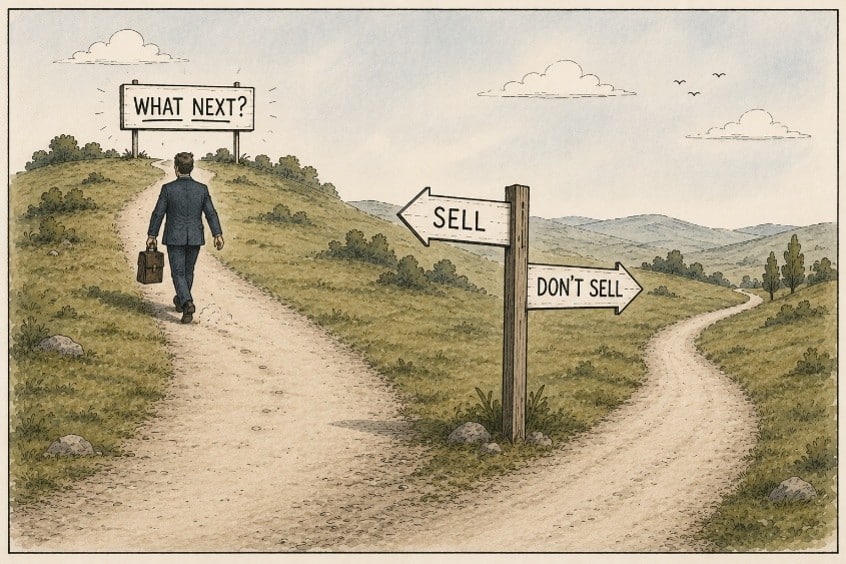
Business owners ask whether this is a good market in which to sell. Boards ask whether now is the right time to divest a non-core operation. Investors debate whether valuations have peaked.
These are all reasonable questions, but they evaluate the transaction largely in isolation.
Rather than asking “Is this a good time to sell?”, we think owners should ask:
Relative to every other opportunity available, is continuing to own this asset my best use of capital?
That subtle shift in perspective can lead to very different conclusions. A great sale price followed by a poor reinvestment can create less wealth than a good sale price followed by great redeployment. Conversely, declining to sell may be exactly right when the existing asset remains the most attractive place for the capital.
The point is not that markets don’t matter. They do. Nor is it that valuation is somehow secondary: every additional dollar realized in a transaction creates more options.
The observation is simply this: the success of a transaction cannot be judged until the proceeds have found their next home.
This way of thinking extends well beyond mergers and acquisitions. The same framework applies whenever capital is being reallocated.
Should a company acquire another business or invest in its existing operations? Raise equity or debt? Repurchase shares or preserve liquidity? Remain private or access public markets? Each of these decisions competes with alternatives and should be evaluated relative to those alternatives – not on its own.
So, is this a good time to sell?
Some readers may be thinking this newsletter sounds suspiciously like an investment banker encouraging everyone to sell. Like asking a barber if you need a haircut. It’s not an unreasonable first reaction. But it misses the point.
There are times when the right advice is to sell, and there are times when the right advice is to wait. There are situations where retaining an asset is the best capital allocation decision available, regardless of how attractive the current market may appear. There are others where selling into a less enthusiastic market proves to be the better long-term decision because the alternatives are even more compelling.
The objective isn’t simply to maximize the price received for an asset. It’s to maximize the long-term value created by the decision as a whole. Those are not always the same thing.
At Fort Capital, that is the conversation we think is worth having. Not simply “Is this a good time to sell?”, but rather “Comparing all my alternatives, what is the best thing to do with my capital?” Sale of an asset or business is an allocation decision.
Click here to read the full 2026 Q2 Newsletter with more market updates, team news, transaction announcements and more.